Have you ever found yourself saying, “Come to the carpet,” “Sit down,” or “Eyes on me” over and over again?
I definitely have.
That’s why call-and-response routines have become one of the most powerful tools in my elementary Spanish classroom. They help students know exactly what to do, make transitions smoother, and create joyful moments of connection, all while giving students more opportunities to hear meaningful Spanish.
The best part? Every routine becomes another opportunity for language acquisition.
Why Call-and-Response Works
Call-and-response isn’t just a fun routine, it’s a powerful tool for building connection, creating consistency, and making students feel confident in the classroom. When students hear a familiar phrase or melody, they immediately know what to do. It’s not about controlling behavior; it’s about creating a classroom where everyone feels connected and successful.
It Builds Connection
Call-and-response creates a shared language between you and your students. Whether it’s a catchy phrase, a rhyme, or a song, these short exchanges become moments of connection. Students aren’t simply following directions, they’re participating in something together.
It Saves Your Voice
Instead of repeating yourself over and over, one familiar cue can communicate exactly what’s expected. Your students learn the routine, and before long, a simple phrase is all it takes to transition from one activity to the next.
It Creates Predictable Routines
Students thrive on consistency. When students know what each call-and-response means, they feel more confident because they know what’s coming next. Predictable routines reduce uncertainty and allow students to focus on learning rather than figuring out what they’re supposed to do.
It Adds Joy to Everyday Moments
Transitions don’t have to feel rushed or boring. A little rhythm, music, movement, or humor can transform ordinary classroom moments into something students genuinely look forward to.
Why I Love Using Call-and-Response in Spanish Class
Call-and-response routines work in any classroom, but I especially love using them in my elementary Spanish classes because they become another source of comprehensible input.
Instead of stopping instruction to give directions in English, I can continue using Spanish naturally throughout the day. Every transition becomes another opportunity for students to hear high-frequency language in context.
Over time, students begin to associate familiar phrases with specific actions, and eventually they no longer need explanations. They simply hear the cue and respond automatically.
Every Routine Has a Job
One thing I want to emphasize is that my call-and-response routines are not just fun chants. Every single one has a purpose.
Students don’t just hear a catchy phrase, they immediately know what action goes with it. Because we use the same cue every single time, these routines quickly become automatic.
Here are a few examples from my classroom.
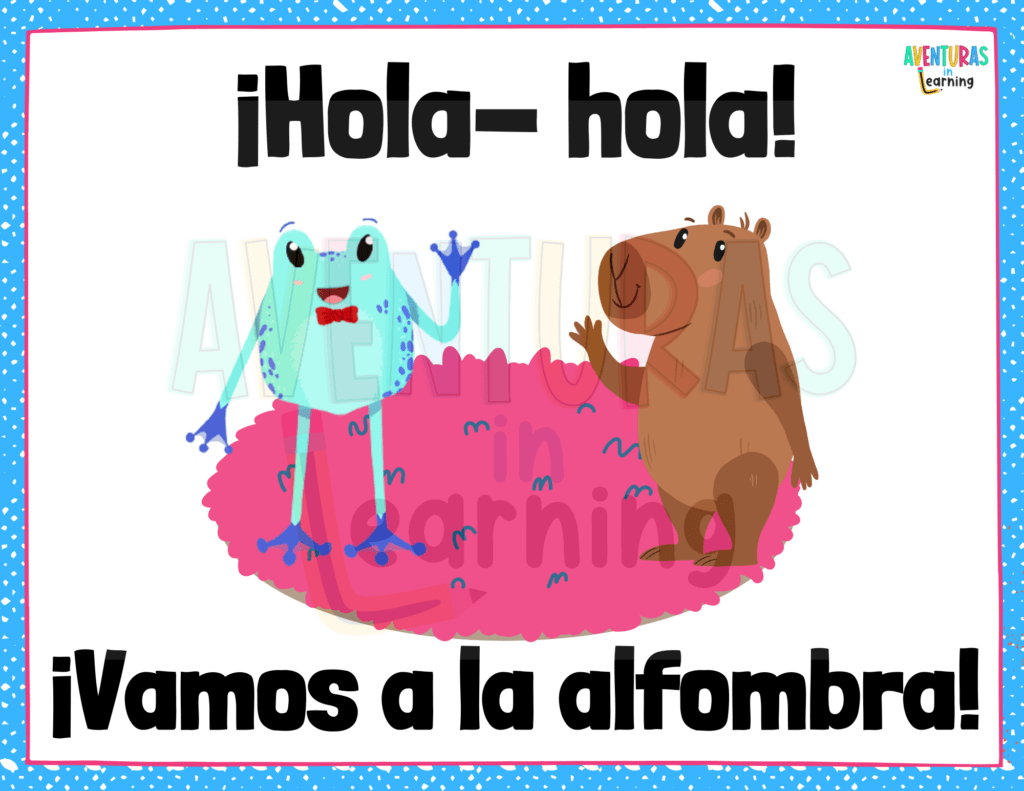
👋 “¡Hola, hola! ¡Vamos a la alfombra!”
This call-and-response has one clear purpose: transitioning from chairs to the rug.
When I say, “¡Hola, hola!” my students immediately respond, “¡Vamos a la alfombra!” and begin walking to the rug. Because we use the same routine every time, students know exactly what to do without additional directions.
I never have to say, “Come to the carpet.” The routine becomes the cue.
🪑 “¡Uno, dos, tres… siéntate!”
This call-and-response signals that it’s time to return to our seats after a game, a story, or a movement activity.
I call out, “¡Uno, dos, tres!” and my students respond, “¡Siéntate!” as they walk back to their chairs and sit down.
One short exchange communicates exactly what’s expected, making transitions quick, predictable, and entirely in Spanish.
⭐ “¡Waka, waka!”
This is one of my favorites because it’s connected to our Classroom Agreements Song, which is sung to the tune of Waka Waka.
When I say, “¡Waka, waka!” my students immediately think about the classroom agreements we’ve practiced since the beginning of the year. Rather than stopping instruction to review expectations, this quick cue reminds them how we learn together, participate respectfully, and take care of one another.
🦎 “¡Calma, calma… respira con Aba la Iguana!”
This call-and-response is our cue to pause, reset, and take a mindful breathing break whenever our classroom energy gets a little too high.
I say, “¡Calma, calma!” and my students respond, “¡Respira con la Iguana!” Then, together, we take a deep breath in and out while slowly counting to ten in Spanish.
This simple routine helps students regulate their emotions, refocus, and return to learning, all while continuing to hear and use meaningful Spanish.
🧹 “¡A limpiar!” → “Doo doo doo doo…”
This call-and-response signals that it’s time to clean up.
I say, “¡A limpiar!” and my students immediately respond, “Doo doo doo doo…” as they begin cleaning up the classroom. They recognize the melody from our clean-up song, so they instantly know it’s time to put materials away and help tidy our learning space.
Because we use the same cue every time, cleanup becomes quick, predictable, and fun, all while reinforcing meaningful Spanish through music and repetition.
Familiar Characters Make Routines Even More Meaningful
I’m especially excited because many of my call-and-response routines feature characters from Aventuras in Learning.
Students already know characters like Aba la Iguana, Maca la Guacamaya, and Lucho Pérez from the stories we’ve read together. Seeing those same characters appear in our daily routines creates another meaningful connection between our stories and our classroom life.
Instead of introducing random characters or phrases, we’re reinforcing language students already know and love.
Tips for Success
If you’re new to call-and-response routines, don’t try to introduce ten different ones during the first week of school.
Start with just one.
Practice it every single day until students respond automatically. Once they’ve mastered it, introduce another routine with a different purpose.
I typically use between three and five call-and-response routines throughout the school year, each connected to a specific action.
The key is consistency.
Remember, every routine should have a job.
When each phrase has a clear purpose, students quickly learn what it means. Before long, transitions become effortless, your classroom feels more connected, and Spanish becomes part of every moment, not just story time or direct instruction.
Ready to Try Them?
If you’d like to use these exact call-and-response routines in your classroom, I’ve created a free resource with printable visuals and classroom cues that you can start using right away.
I hope these routines help you create a classroom where students feel connected, confident, and excited to use Spanish every single day.

Remember: Every routine is another opportunity for language acquisition. The more meaningful Spanish your students hear throughout the day, the more opportunities they have to acquire the language naturally. Get your Free resource here!
Looking for an Elementary Spanish Curriculum?
Try Aventuras in Learning for free! Explore 3 complete story units with videos, games, printables, and teaching resources to see how easy story-based language learning can be.
✨ Create a free account and explore 3 complete stories, one from each level—at no cost!


Leave a Reply